
TIP UPJŠ — Technologický a inovačný park metabolitemarket.com

A9 Secondary Metabolites · Depside · Evernia mesomorpha · 2026 publication

Divaricatic Acid Antimicrobial & Antiparasitic Line

Gram-positive antibacterial activity including MRSA, schistosomicidal activity against adult S. mansoni, and the second-strongest nematocidal hit (LC50 77.27 µM) in our 2026 panel.

Evidence
Peer-reviewed 2026 + literature · in vitro
Stage
Pilot on request
Indicative
Price on requestnegotiable by scope and application
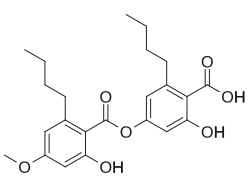
Chemical structure of divaricatic acid
Divaricatic Acid — structural formula

Scientific summary

Divaricatic acid is a depside consisting of two substituted hydroxybenzoic acid rings linked by an ester bond. It is reported from multiple lichens, including Evernia mesomorpha, Ophioparma ventosa and Ramalina species. The literature supports several distinct bioactivity directions: Gram-positive antibacterial activity, antiproliferative activity in melanoma cell models, schistosomicidal activity against Schistosoma mansoni, and anthelmintic activity.

Biological rationale as published

  • Antimicrobial. Purified divaricatic acid inhibited several Gram-positive organisms, including S. aureus (MRSA), S. epidermidis, Streptococcus mutans, Enterococcus faecium and Bacillus subtilis; antifungal activity against Candida albicans was also reported.
  • Antiproliferative. Melanoma-cell studies reported concentration-dependent growth inhibition.
  • Antiparasitic. Against adult S. mansoni, divaricatic acid altered motility and caused mortality and marked tegumental/ultrastructural damage; no cytotoxicity was observed in human peripheral blood mononuclear cells in that study.
  • Anthelmintic. C. elegans work found strong survival loss and concentration-dependent mortality (LC50 77.27 µM). SAR analysis suggested that an intact depside, an aliphatic chain and a carboxylic group contribute to activity across the 17-compound panel.

Applications

  • Antimicrobial discovery and Gram-positive antibacterial screening
  • Antiparasitic / anthelmintic lead discovery (C. elegans, Schistosoma)
  • Comparative antiproliferative screening in melanoma cell lines
  • Structure–activity relationship studies of lichen depsides

Assays & readouts available

  • MTT / cell viability, LDH release
  • ROS assay; Comet (DNA damage) assay
  • Western blotting
  • Melanoma cell assay; CCD-18Co cell culture
  • HPLC and NMR; SAR analysis

Specification

Compound classDepside (lichen secondary metabolite)
Biological sourceEvernia mesomorpha, Ophioparma ventosa, Ramalina spp. and other lichens
Evidence statusPeer-reviewed in vitro evidence across antimicrobial, antiproliferative, antiparasitic and anthelmintic activity
Molecular formulaC21H24O7 · MW 388.4 g/mol
Typical pilotBioactivity pilot 4–8 weeks, or custom research pilot 8–12 weeks
EngagementFeasibility scan · pilot · licensing · co-development
Indicative pricePrice on request, negotiable by scope and application

Publications

  1. Frenák R, Vaneková Z, Lager S, Medvecová V, Kello M, Rollinger JM, Goga M. Lichens as a Source of Nematocidal Compounds: Identification of Sphaerophorin and Divaricatic Acid Active against Caenorhabditis elegans. ACS Omega 2026. — doi:10.1021/acsomega.6c05106
  2. Schistosomicidal effect of divaricatic acid against adult worms of Schistosoma mansoni. Acta Tropica 2021. — PubMed 34273313
  3. Antimicrobial Activity of Divaricatic Acid Isolated from the Lichen Evernia mesomorpha against Methicillin-Resistant Staphylococcus aureus. Molecules 2018. — PubMed 30477128
  4. Cytotoxic evaluation of phenolic compounds from lichens against melanoma cells. Chem Pharm Bull 2013. — PubMed 23207680

All published findings for this compound are in vitro. They are not evidence of clinical efficacy, safety in humans, or regulatory status, and we do not present them as such.

What happens next

  1. Book a call or send an inquiry. Tell us the target, the application and the timeline.
  2. We answer within three working days — including when the answer is that we cannot help.
  3. NDA before disclosure, if you need one. Tick the box on the form.
  4. Feasibility scan or pilot proposal with a defined scope, deliverable and price.

Book a 30-minute discovery call Send an inquiry

Common questions

How does an engagement start?
With a free 30-minute discovery call. We establish whether there is a fit and what the right next step is. Nothing is committed at that point.
Can we sign an NDA before we describe our project?
Yes. Tick the NDA box on the inquiry form and we arrange it before any disclosure.
Are the prices on this site binding?
No. They are indicative ranges so that you can size a project before contacting us. Final terms are negotiated per scope.
How quickly do you reply?
Every inquiry is acknowledged within one working day and answered by the responsible group leader within three.
What happens if you cannot help?
We say so, early, and where we can we point you to someone who can. A negative feasibility answer delivered quickly is a useful result.

Related in Secondary Metabolites

A82026 publication

Depside · Sphaerophorus fragilis

Sphaerophorin Anthelmintic Line

The most active of 17 lichen metabolites against C. elegans in our 2026 study (LC50 22.07 µM). Earlier work adds melanoma-cell growth inhibition with caspase-3 activation and protection of DNA from radical damage.

  • Anthelmintic screening
  • Melanoma model
  • Antioxidant
Evidence
Peer-reviewed 2026 · in vitro
Stage
Pilot on request
Indicative
Price on requestnegotiable by scope and application
A10

Depsidone · Stereocaulon spp.

Lobaric Acid Anti-inflammatory Line

Published inhibition of 5-lipoxygenase (IC50 7.3 µM) and platelet 12(S)-LOX, suppression of NF-κB/MAPK signalling in macrophages, and G2/M arrest with apoptosis in HeLa and HCT116 cells.

  • Anti-inflammatory
  • 5-LOX / 12-LOX
  • NF-κB / PPAR-γ
Evidence
Published literature · in vitro
Stage
Pilot on request
Indicative
Price on requestnegotiable by scope and application
A11

β-Orcinol depsidone · Usnea, Xanthoparmelia

Stictic Acid Antioxidant Line

A β-orcinol depsidone with published radical-scavenging (DPPH, superoxide), apoptotic activity in primary hepatocytes and antimicrobial data — and a chemically measurable HPLC reference metabolite.

  • Antioxidant
  • Antimicrobial
  • HPLC reference
Evidence
Published literature · in vitro
Stage
Pilot on request
Indicative
Price on requestnegotiable by scope and application

Tell us what you are trying to achieve.

A free 30-minute call establishes whether there is a fit and what the right next step is. Every inquiry is acknowledged within one working day and answered by the responsible group leader within three.